This article was previously published on 7/13/2022 and updated on 5/13/2026
RFID Chip Types Explained: LF, HF, NFC, and UHF
RFID chips are small, highly integrated microchips, also known as integrated circuits (ICs), embedded within RFID labels, tags, or cards. These chips contain a microprocessor, memory, and control logic that allow them to store and transmit data. When exposed to radio waves from an RFID reader, the chip is activated, processes the signal, and transmits its stored information via the antenna.
Most RFID chips used in labeling applications are passive, meaning they do not have an internal power source. Instead, they rely on energy transmitted by the reader to operate. The chip’s memory typically stores a unique identifier, such as an Electronic Product Code (EPC), along with other data used for tracking, authentication, or supply chain visibility.
RFID technology continues to evolve, with newer chips offering expanded memory, improved sensitivity, and additional features such as password protection and data encryption. These capabilities support a wide range of applications, including inventory tracking, logistics, product authentication, and consumer interaction.
RFID Chip Types by Frequency
RFID chips are categorized by operating frequency, which determines read range, data behavior, and application use. RFID systems primarily operate within three frequency bands: low frequency (LF), high frequency (HF), and ultra-high frequency (UHF). These classifications are defined and standardized by GS1, which outlines how each frequency behaves in different environments and applications.
Understanding the differences between these frequency bands is critical when selecting the right RFID chip for a specific use case.
Low Frequency (LF)
Low-frequency RFID systems typically operate at 125 kHz or 134 kHz. This band provides a short read range, generally between 10 and 50 cm, and operates at a slower data transfer rate compared to higher frequencies. However, LF signals are less sensitive to interference from materials such as metal and liquids, making them reliable in challenging environments.
LF RFID is commonly used in applications such as animal identification and physical access control. These systems are governed by standards such as ISO/IEC 18000-2. Because LF frequency allocations and power levels vary slightly by region, LF systems are not always considered globally uniform.
High Frequency (HF)
High Frequency RFID operates at 13.56 MHz and is widely used for applications requiring reliable, short-range communication. Typical read ranges range from 10 cm to 1 meter, depending on system configuration.
HF systems offer stable performance across a variety of materials and are commonly used in applications such as transport ticketing, event access, healthcare labeling, and secure document identification, including e-passports. HF RFID is supported by standards such as ISO/IEC 15693 and ISO/IEC 18000-3.
Near Field Communication (NFC)
Near Field Communication (NFC) is a subset of HF RFID that also operates at 13.56 MHz. It is designed for very short-range, interactive communication, typically within a few centimeters. NFC is widely used for smartphone-based applications such as authentication, payments, and data exchange.
NFC technology is defined by standards including ISO/IEC 18092 and ECMA-340.
Ultra-High Frequency (UHF)
Ultra-High Frequency RFID systems operate within the 860 to 960 MHz range, depending on regional regulations. These systems support significantly longer read ranges, often up to several meters, and can read multiple tags simultaneously.
Passive UHF RFID, also known as RAIN RFID, is commonly used in retail inventory management, logistics, and supply chain tracking. These systems comply with GS1 EPC Gen2 and ISO/IEC 18000-63 standards, enabling consistent data exchange across global supply chains.
UHF RFID is particularly well-suited for high-volume environments where speed, scalability, and item-level visibility are required.
RFID frequency selection affects everything from read distance to data handling and environmental performance. The table below summarizes how LF, HF, NFC, and UHF systems compare across key technical factors.
Understanding how each RFID frequency performs across key parameters can help guide chip selection for specific applications.
| Frequency Type | Operating Range | Typical Read Distance | Data Behavior | Environmental Sensitivity | Common Applications |
| Low Frequency (LF) | 125–134 kHz | ~10–50 cm | Slower data transfer; single-tag reads | Low sensitivity to metal and liquids | Animal identification, access control |
| High Frequency (HF) | 13.56 MHz | ~10 cm to 1 m | Stable communication; moderate data rates | Moderate sensitivity to interference | Ticketing, healthcare, smart cards, secure documents |
| NFC (HF subset) | 13.56 MHz | <10 cm | Short-range, interactive, two-way communication | Low sensitivity due to close proximity | Mobile authentication, payments, consumer interaction |
| Ultra-High Frequency (UHF) | 860–960 MHz | Up to several meters (environment-dependent) | Fast data transfer; multi-tag reading | Higher sensitivity to metal, liquids, and dense materials | Retail inventory, logistics, supply chain tracking |
How to Choose the Right RFID Chip for Your Application
Selecting the appropriate RFID chip requires aligning the technology with the specific conditions in which it will operate. Frequency alone does not determine performance. Environment, data requirements, and system design all play a role in how effectively an RFID solution performs.
Before selecting a chip type, it is important to evaluate the following factors:
- Material and Environment
Consider whether the label will be applied to metal, liquids, corrugated packaging, or mixed materials. LF systems tend to perform more consistently in environments with metal or moisture, while UHF systems may require specialized inlays or placement strategies to maintain read reliability. - Read Range Requirements
Applications that require close-range verification, such as authentication or secure access, are typically suited for HF or NFC. Applications involving bulk inventory or pallet-level tracking often require UHF to support longer read distances. - Data and Interaction Needs
Some applications require only a unique identifier, while others require additional data storage or user interaction. NFC, for example, supports two-way communication with smartphones, while UHF systems are optimized for rapid identification of large volumes of items. - Throughput and Scale
High-volume environments such as retail distribution or manufacturing benefit from UHF systems that support fast, multi-tag reading. Lower-volume or controlled environments may prioritize stability over speed. - System Integration
Compatibility with existing readers, encoding standards, and software platforms should be confirmed early. Following GS1 EPC standards helps ensure consistent data formatting and interoperability across systems.
Evaluating these factors early in the process helps reduce performance issues and ensures that the selected RFID chip aligns with operational requirements.
For a broader evaluation of active and passive options, read range, placement, materials, and environmental conditions, review our guide to selecting the right RFID tag.
RFID Chip Selection and Label Manufacturing Considerations
RFID chip performance is influenced not only by the chip itself, but also by how it is integrated into the label or tag. The relationship between the chip, antenna, and surrounding materials affects how consistently the tag can be read.
Accurate inlay placement is essential. The chip must be properly aligned with the antenna and positioned consistently within the label construction. Variations in placement, tension, or material handling during production can affect read reliability, particularly in high-speed converting environments.
Material selection also plays a role. Facestock, adhesives, and substrates can influence signal propagation and durability. Labels applied to curved surfaces or exposed to handling stress may require different constructions to maintain consistent performance.
For this reason, many RFID implementations include testing under real-world conditions to confirm that the selected chip and label construction perform as expected before scaling production.
Tamarack Equipment for RFID Inlay and Label Production
The performance of RFID labels begins with consistent inlay placement during the converting process. Tamarack® Products provides RFID inlay insertion systems designed to integrate into both inline and offline production environments.
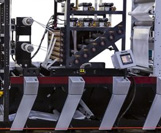
The Tamarack MVW Inline RFID Inlay Insertion Equipment produces RFID labels, tickets, and tags in a single pass on a new or existing flexo press. The servo-driven system is typically installed after print stations and before the finishing section, supporting integration into the press line. It is configured to insert dry inlays, with wet inlay capability also available, and includes operator-friendly, touch-screen controls, fast setup, and a simple web path. Optional features include static elimination systems and reader, marker, and encoder integration.
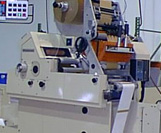
The Tamarack MVW Offline RFID Inlay Insertion Equipment provides a complete offline platform for inserting RFID inlays into a pre-printed web. The system includes a re-registration mechanism to align inlay placement to print and can be configured for wet inlays, dry inlays, or both. It supports multiple lanes for higher-volume production and offers options such as reader and marker encoder integration, multiple die-cut units, and roll-to-roll or roll-to-tag/ticket configurations.
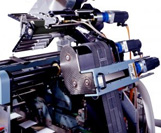
Tamarack also offers RFID encoding capabilities through the Tamarack EZ RFID Encoder, which can be integrated into converting workflows to support encoding and verification during label production.
Tamarack equipment helps converters produce RFID labels and tags designed for consistent performance across a range of applications with accurate inlay placement and integrated RFID encoding within the converting process.
Understanding RFID chip types helps companies select the right technology for a given application. Differences in frequency, read behavior, and environmental performance all influence how effectively an RFID system operates. By aligning chip selection with application requirements and maintaining consistency in label construction and encoding, organizations can build RFID systems that support reliable identification and data capture.
Tamarack® Products engineers precision RFID inlay insertion and encoding equipment for converters producing labels, tags, and tickets. We provide inline and offline systems designed to support accurate inlay placement and integrated RFID workflows across a range of applications. Contact us today to explore solutions for RFID chip types.