This article was originally published on 8/3/2023 and updated on 10/6/2026
RFID insertion helps converters produce labels, tags, and tickets for warehouse management applications. These RFID-enabled products may be applied to cartons, pallets, containers, returnable assets, tools, files, apparel, or finished goods that need to be identified as they move through a facility.
The warehouse system may include readers, antennas, software, dock doors, portals, handheld devices, and inventory records. The converter’s role is to produce the RFID product that carries the inlay and fits the customer’s application, material, print, encoding, and finishing requirements.
FID Labels in Warehouse Management
Warehouse RFID applications use labels or tags to identify items via radio-frequency technology. Unlike barcode scanning, RFID does not require direct line-of-sight scanning. This can support applications where items are packed in cases, stacked on pallets, staged at docks, or counted in groups.
RFID performance depends on the full system, including the tag, reader, antenna, software, item material, label placement, and warehouse environment. For converters, the practical production requirement is consistent RFID label or tag construction with accurate inlay placement.
RFID Products Used in Warehouse Applications
Warehouse applications may use several RFID product formats. Case labels may support shipment verification. Pallet labels may support dock or staging reads. Asset labels may be used on tools, equipment, containers, or returnable assets. Apparel and retail labels may support item-level inventory.
Each format can have different material, adhesive, inlay, print, lane count, and finished roll requirements. A returnable asset label may not use the same construction as a shipping label or apparel tag. The production workflow should be configured around the actual product being produced.
RFID Insertion Requirements for Warehouse Labels
RFID warehouse labels require accurate inlay placement, repeatable registration, controlled web handling, and a finished format that works with the customer’s application process. Finishing may include die cutting, slitting, rewinding, or roll-to-tag/ticket production, depending on the job.
Some warehouse labels also require encoded data before delivery. Encoding can include item identifiers, serial numbers, EPCs, or other information specified by the customer’s inventory or warehouse management system.
Inline RFID Insertion for Warehouse Labels
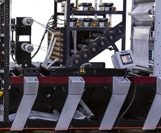
Inline RFID insertion is used when inlay placement runs as part of a flexo press workflow. The Tamarack MVW Inline RFID Inlay Insertion Equipment produces RFID labels, tickets, and tags in a single pass on a new or existing flexo press.
The equipment is typically installed after the press print stations and before the finishing section. Tamarack’s MVW Inline RFID equipment is servo-driven and designed for dry inlay insertion, with wet inlay insertion also available. Operator-friendly controls, fast setup, and a simple web path support all run lengths–short-run jobs, trials, and high-volume production work.
Offline RFID Insertion for Pre-Printed or Blank Warehouse Labels
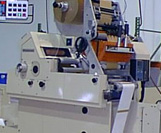
Offline RFID insertion is used when warehouse labels, tags, or tickets are printed, or do not require printing, before the inlay is placed. The Tamarack MVW Offline RFID Inlay Insertion Equipment inserts RFID inlays into pre-printed webs and includes re-registration to help align the inlay with the print.
The offline platform can be configured for wet, dry, or both inlays. It also supports multiple lanes for higher-volume production. Options include reader, marker, and encoder integration, multiple die-cut units in the finishing section, and roll-to-roll or roll-to-tag/ticket production.
Encoding and Testing Warehouse RFID Labels
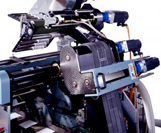
Warehouse management applications often depend on the correct data being written to the RFID inlay. The Tamarack EZ RFID Encode supports offline encoding, testing, and, if required, locking. Labels that do not pass the testing protocol can be marked by communicating with the reader/encoder and the inkjet system. Additionally, variable data printing can be added to print bar codes on the product which will typically match the data encoded into the inlay chip.
After testing, the label roll can be slit if it is multi-lane and rewound into finished RFID-enabled labels. EZ RFID Encode can also be equipped for UHF and HF/NFC, with multi-lane offline configurations available.
RFID Insertion Equipment for Warehouse Management Applications
RFID labels used in warehouse management need to match the product, substrate, inlay, data requirements, and finished delivery format. Tamarack® Products works with converters to configure RFID insertion and encoding equipment for inline production, offline insertion, and secondary encoding and verification. Tamarack also provides custom web finishing equipment for applications that require equipment customized around the converter’s workflow.
Tamarack® Products engineers RFID insertion and encoding equipment for converters producing warehouse labels, tags, and tickets. Tamarack provides inline, offline, encoding, and custom equipment solutions designed to support accurate inlay placement, controlled web handling, and flexible production workflows. Contact Tamarack today to discuss RFID insertion equipment for warehouse management, label, and tag production.