Table of Contents
This article was previously published on 4/13/2023 and updated on 7/18/2026
How can RFID labels help track packaging throughout the supply chain?
Modern packaging does more than protect products. It also helps identify, track, and manage that product throughout the supply chain. As distribution networks grow more complex and accuracy matters more, packaging needs to support faster data capture and clearer visibility.
RFID helps make that possible by building identification into labels and packaging materials. Instead of relying on manual scans or separate systems, RFID enables companies to automatically identify and track products as they move through production, warehousing, and distribution.
Growth in RFID-enabled packaging is closely tied to the broader expansion of smart packaging technologies. Market analysis from Mordor Intelligence indicates that the global smart packaging market is valued at over $25 billion today and is projected to exceed $36 billion within the next several years, with steady annual growth in the 7% range.
This growth is driven in part by increasing adoption of connected packaging solutions, including RFID labels and inlays, which support real-time tracking, traceability, and data-driven supply chain operations.
How RFID Is Applied in Packaging Environments
In packaging operations, RFID is typically integrated as a smart label or inlay that carries a unique identifier. Once applied, that identifier becomes part of the product’s digital record, allowing it to be tracked without manual input.
This capability changes how packaging functions within an operation. Instead of acting as a static label, RFID-enabled packaging becomes an active data point that can be read at multiple stages: during production, at receiving, throughout storage, and at shipment.
Industry packaging resources note that RFID enables continuous tracking and tracing of packaged goods, supporting visibility across manufacturing and distribution workflows.
Improving Inventory Visibility Without Adding Complexity
Inventory accuracy is one of the most immediate benefits of RFID-enabled packaging. Traditional processes often rely on manual scans or periodic counts, which can introduce delays and inconsistencies. RFID removes much of that friction by capturing data automatically as items move.
In practical terms, this means inventory updates occur in real time rather than in batches. Items can be identified as they pass through a dock door, move between storage zones, or are picked for shipment. The result is a more accurate view of inventory without increasing labor requirements.
Because RFID does not require line-of-sight scanning, it can also identify items stored in boxes, on pallets, or in dense storage environments, something that barcode systems cannot do efficiently.
Traceability Across the Packaging Lifecycle
RFID also strengthens traceability by linking each packaged item to a unique identity. That identity can be tracked from packaging through distribution and, in some cases, to the end user. This level of traceability supports several operational needs. It improves recall management by enabling companies to quickly isolate specific items. It also helps coordinate movement across multiple facilities by providing consistent, item-level visibility.
Packaging-focused research, such as this article published in Packaging Europe, RFID: Traceability in a globalized supply chain, highlights RFID’s role in tracking and tracing goods throughout the supply chain, improving both transparency and control in logistics environments.
Supporting Product Security and Authentication
For certain industries, packaging must also support product protection and authentication. RFID enables this by assigning a unique identifier to each item, making it easier to verify authenticity and detect irregular movement. Unlike traditional labels, RFID tags can be read automatically and integrated into verification workflows at multiple points. This allows companies to confirm that a product is where it should be and has moved through the expected process.
This capability is particularly important in applications where product integrity, compliance, or brand protection is a priority.
Tamarack Equipment for RFID Inlay Applications
The effectiveness of RFID in packaging applications depends on the quality and consistency of the RFID labels and inlays used. Tamarack® Products provides RFID inlay insertion systems designed to support reliable label production in both inline and offline converting environments.
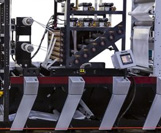
The Tamarack MVW Inline RFID Inlay Insertion Equipment produces RFID labels, tickets, and tags in a single pass on a new or existing flexo press. The servo-driven system is typically installed after print stations and before the finishing section, supporting integration into the press line. It is configured to insert multiple lanes of dry or wet inlays and features operator-friendly controls, fast setup, and an intuitive, simple web path. Inline inspection assures RFID readability and options are available for data encoding and variable data printing.
The Tamarack MVW Offline RFID Inlay Insertion Equipment provides a complete offline platform for inserting RFID inlays into a pre-printed web for converters who need to print on multiple presses, digital or flexo. The system includes a re-registration mechanism to align inlay placement to print and can be configured for wet inlays, dry inlays, or both. It supports multiple lanes for higher-volume production and includes complete inspection with readers with optional encoding to add data to the chip. Completely modular, the MVW allows the converter to create the ideal system for their planned production with the possibility of multiple die-cut units, over and under lamination stations, and roll-to-roll or roll-to-tag/ticket configurations.
Tamarack also offers offline RFID encoding capabilities through the Tamarack EZ RFID Encode, which is designed to allow the converter to encode as a secondary process to inlay insertion. Also capable of multi-lane operation, at speeds from 80-250 FPM depending on the length of the label and inlay, the EZ RFID Encode is offering converters a high-speed option to this formerly slow process.
By supporting accurate inlay placement and high speed encoding, Tamarack equipment helps converters produce RFID labels and tags designed for consistent performance in packaging and supply chain applications.
RFID technology provides packaging companies with a scalable way to improve visibility, automate processes, and enhance product tracking across the supply chain.
From inventory management and traceability to security and smart packaging applications, RFID enables packaging to play a more active role in data-driven operations. As adoption continues to grow, RFID is becoming an important part of modern packaging strategies.
Tamarack® Products engineers precision RFID inlay insertion and encoding equipment for converters producing labels, tags, and packaging applications. We provide inline and offline systems designed to support accurate inlay placement and reliable RFID integration across packaging and supply chain operations. Contact us today to explore RFID solutions for packaging companies.