This article was originally published on 4/27/2023 and updated on 5/27/2026
RFID Tool Tracking: Improve Asset Control and Visibility
RFID tags and labels are used across many industries to identify and track physical assets. Tool tracking with RFID focuses on managing tools throughout their lifecycle, providing visibility into location, usage, and availability without relying on manual processes.
As operations scale and tools move between locations, teams, and job sites, maintaining accurate records becomes more difficult. RFID tool-tracking systems help address this by automating identification and tracking, thereby improving control over critical assets.
Why Use RFID Tool Tracking
Managing tools and equipment is essential for maintaining productivity, controlling costs, and supporting operational workflows. RFID tool tracking enables real-time monitoring of tools and reduces reliance on manual check-in and check-out processes.
An RFID-based system allows organizations to:
- Track tool location within a facility or across job sites
- Monitor movement between departments or teams
- Manage tool check-out and return activity
- Support preventive maintenance scheduling
- Reduce loss or misplacement of high-value tools
By automating these processes, companies gain better visibility into tool availability and usage without adding administrative burden.
How RFID Tool Tracking Works in Practice
RFID tool tracking systems combine tagged tools, readers, and software to create a connected tracking environment.
- RFID Tags are attached to tools or equipment
- Readers are placed at key points such as tool cribs, exits, or work zones
- Software systems record movement, status, and usage data
When a tagged tool passes a reader, the system automatically logs its movement. This allows organizations to track when tools are issued, where they are used, and when they are returned.
Unlike barcode systems, RFID does not require direct scanning. Multiple tools can be identified simultaneously, even when stored in containers or racks.
Common RFID Tool Tracking Applications
RFID tool tracking is used across a wide range of industries where tools must be controlled, shared, or monitored.
- Manufacturing
Track tools, dies, and equipment used in production processes and monitor usage across shifts. - Construction and Field Services
Monitor tools across job sites and vehicles to reduce loss and improve accountability. - Healthcare
Track medical equipment and tools to ensure availability and support maintenance schedules. - Tool Rental Operations
Manage inventory, monitor rentals, and track returns across multiple locations. - Maintenance and Repair Operations (MRO)
Track specialized tools used in maintenance workflows and ensure they are available when needed.
These applications all benefit from improved visibility and reduced manual tracking.
Types of Tools and Assets Ideal for RFID Tracking
Any asset that requires tracking, maintenance, or controlled access can benefit from RFID tool tracking. Common examples include:
- Hand tools
- Power tools
- Computer equipment
- Inventory and consumables
- Rental products
- Manufacturing tools and dies
- Raw materials
- Documents and records
RFID is particularly useful for assets that are frequently moved, shared across teams, or stored in multiple locations.
Operational Benefits of RFID Tool Tracking
RFID tool tracking provides several operational advantages that improve efficiency and asset control.
- Improved Tool Visibility
Organizations can quickly locate tools without manual searching, reducing downtime. - Reduced Loss and Misplacement
Tracking movement helps prevent tools from being lost, misplaced, or removed without authorization. - Support for Preventive Maintenance
Usage data can be used to schedule maintenance based on actual tool activity rather than fixed intervals. - Streamlined Workflows
Automated tracking reduces the need for manual logging and improves process consistency. - Better Resource Utilization
Understanding how often tools are used helps organizations optimize inventory levels and purchasing decisions.
RFID Advantages Over Barcode-Based Tracking
RFID offers several functional advantages over traditional barcode systems.
- Tags can be read without line-of-sight
- Multiple items can be read simultaneously
- Data capture is automated rather than manual
- Tags can be read through packaging or storage containers
These capabilities make RFID more efficient for environments where tools are stored in bulk, frequently moved, or difficult to access.
Tamarack Equipment for RFID Tool Tracking Labels
The effectiveness of RFID tool tracking depends on the quality and consistency of the RFID labels and tags used throughout the system. Tamarack® Products provides RFID inlay insertion systems designed to support reliable label production in both inline and offline converting environments.
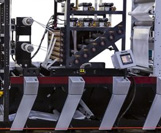
The Tamarack MVW Inline RFID Inlay Insertion Equipment produces RFID labels, tickets, and tags in a single pass on a new or existing flexo press. The servo-driven system is typically installed after print stations and before the finishing section, supporting integration into the press line. It is configured to insert dry inlays, with wet inlay capability also available, and includes operator-friendly controls, fast setup, and a simple web path. Optional features include static elimination systems and integration with the reader, marker, and encoder.
The Tamarack MVW Offline RFID Inlay Insertion Equipment provides a complete offline platform for inserting RFID inlays into a pre-printed web. The system includes a re-registration mechanism to align inlay placement to print and can be configured for wet or dry inlays. It supports multiple lanes for high-volume throughput and offers options such as reader and marker encoder integration, multiple die-cut units, and roll-to-roll or roll-to-tag/ticket configurations.
Tamarack also offers RFID encoding capabilities with the EZ RFID Encoder, which can be integrated into converting workflows to support encoding and verification during label production.
By supporting accurate inlay placement and integrated encoding, Tamarack equipment helps converters produce RFID labels and tags that deliver consistent performance in tool-tracking and asset-management applications.
RFID tool tracking provides a practical way to improve asset visibility, reduce manual processes, and support more efficient operations. By automating identification and tracking, organizations can better manage tools across locations, teams, and workflows. As asset tracking requirements continue to grow, RFID offers a scalable approach to maintaining control and improving operational reliability.
Tamarack® Products engineers precision RFID inlay insertion and encoding equipment for converters producing labels, tags, and tickets. We provide inline and offline systems designed to support accurate inlay placement and reliable RFID workflows for asset and tool tracking applications. Contact us today to explore RFID solutions for tool tracking.