
Why RFID’s Carbon Footprint Deserves Attention
The carbon footprint of RFID systems is increasingly under scrutiny as businesses push toward more sustainable operations. While RFID has long been valued for improving asset visibility and supply chain accuracy, it’s essential to understand the environmental trade-offs, especially compared to traditional barcodes. That begins with assessing each system’s Product Carbon Footprint (PCF) across the entire lifecycle.
Lifecycle Analysis (LCA) breaks down environmental impact into stages: materials, manufacturing, use, and end-of-life. When applied to RFID and barcode technologies, this methodology reveals that RFID generally carries a higher per-unit carbon cost, primarily due to the use of silicon chips, metallic antennas, and added electronics. However, RFID’s system-level efficiencies, like reducing spoilage, transport emissions, and reverse logistics, can offset this footprint over time.
Companies embracing Environmental, Social, and Governance (ESG) frameworks are starting to ask hard questions: Is RFID a greener solution when viewed through a lifecycle lens? Or does the simplicity of barcodes offer a lower environmental burden overall? Understanding each system’s emissions profile helps organizations make informed choices about labeling and tracking technologies.
Materials and Manufacturing Footprint: RFID vs. Barcodes
The most immediate contributor to the carbon footprint of RFID is its component complexity. Most RFID inlays contain a silicon chip, a metallic antenna (usually copper, aluminum, or silver), adhesives, and a substrate made of plastic, PET, or paper. The fabrication of silicon chips alone involves energy-intensive semiconductor processes with high embedded emissions per gram. These materials increase the embedded carbon cost of each RFID tag compared to a traditional barcode label.
Barcodes, by contrast, typically consist of paper or plastic stock printed with ink, using conventional printing processes. With no electronic parts and minimal processing, barcodes have a significantly lower carbon footprint during manufacturing. However, innovation is closing the gap. Emerging technologies, such as chipless RFID, paper-based inlays, and bio-based adhesives, are helping to reduce the carbon intensity of RFID.
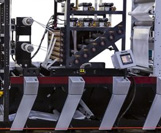
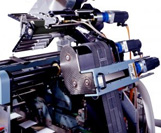
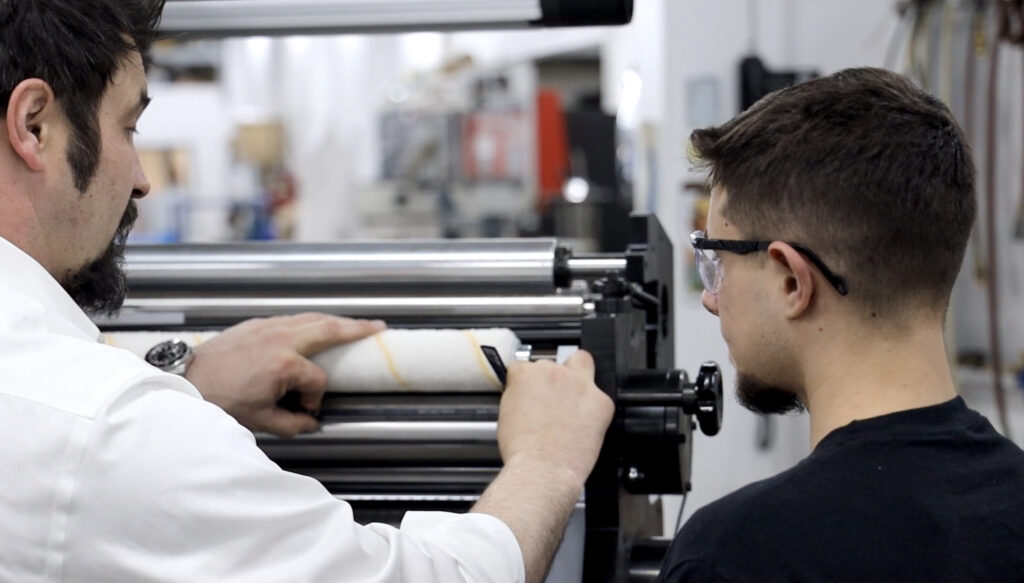
RFID inlay insertion systems support these material innovations by enabling precise, waste-minimized integration into labels and packaging, reducing material overuse during production.
Distribution and Use Phase Energy Use
Once tags and labels are produced, their operational impact begins to unfold. In this phase, RFID systems draw more energy than barcodes, due to both hardware and infrastructure requirements.
RFID systems rely on electromagnetic readers, antennas, and data-processing servers to scan and process tag data. While passive RFID tags don’t contain a battery, they must still be energized by a reader, which consumes electricity. In large-scale deployments, such as warehouses or logistics hubs, dozens of readers may run continuously, generating ongoing energy demand. Barcode systems, in contrast, typically require handheld or stationary optical scanners that use less power per read event. Because barcodes are read on demand and not via ambient scanning zones, their energy use tends to be intermittent and lower over time.
However, RFID can enable downstream carbon reductions by:
- Increasing inventory accuracy, which reduces stockouts and overstocks
- Preventing product waste, particularly in perishable goods and pharmaceuticals
- Enabling more efficient truck loading, route planning, and returns handling through real-time visibility
These indirect savings may outweigh RFID’s higher power draw when evaluated on a whole system level. A 2023 Rain Alliance report highlights how RFID helped one grocery retailer reduce spoilage by 20%, cutting not only food waste but also the associated transportation emissions. Learn more about RAIN RFID technology.
End-of-Life and Recycling Considerations
End-of-life processing is another area where the carbon footprint of RFID diverges from barcodes. Most RFID inlays are not curbside recyclable due to the mix of materials: metals, adhesives, and electronic components bonded to substrates. These materials often end up in landfills or specialized e-waste streams.
In contrast, traditional barcode labels, especially those printed on paper with soy or water-based inks, can often be recycled with standard packaging materials, assuming adhesives and coatings are minimal. This gives barcodes an environmental advantage in circular economy initiatives and waste-reduction programs.
But the RFID industry is evolving. New inlay designs with biodegradable substrates, metal-free antennas, and chipless architectures are emerging. Some manufacturers now offer paper-based RFID tags that decompose like conventional labels, making RFID more compatible with sustainable packaging practices.
For companies managing large volumes of tagged items, implementing tag recovery programs and choosing reusable RFID hard tags for closed-loop environments (e.g., pallets, bins, containers) can drastically improve lifecycle emissions performance.
Minimizing the Carbon Footprint of RFID: Best Practices and Future Trends
While RFID tags may carry a higher initial environmental burden than traditional barcodes, thoughtful implementation can significantly reduce their net impact. Many companies are already taking proactive steps to shrink the carbon footprint of RFID by optimizing material use, extending tag life, and improving system-level efficiency.
Here are several practical strategies to reduce emissions across the RFID lifecycle:
- Use Reusable Hard Tags: For closed-loop applications, such as asset tracking or returnable transport items (RTIs), hard RFID tags can be reused hundreds of times, spreading their embedded carbon footprint over a longer lifespan.
- Choose Eco-Friendly Inlays: Vendors now offer paper-based RFID inlays and antennas made from aluminum or printed conductive inks, which are easier to recycle and less resource-intensive than traditional copper or silver.
- Manage Reader Power Cycles: RFID readers often remain powered 24/7. Implementing intelligent reader scheduling, idle timers, or motion-activated triggers can reduce energy usage.
- Improve Data Efficiency: Minimizing unnecessary backend transmissions and using edge computing can reduce the energy load from data centers that support real-time RFID tracking.
- Design for Disassembly: Ensuring RFID tags can be separated from primary packaging at the recycling stage can help prevent contamination and support circularity goals.
Looking ahead, the growing demand for Digital Product Passports (DPPs) and increased traceability under new EU regulations will enhance the role of RFID in sustainable supply chains. Integrators who embed environmental accountability into RFID system design will be better positioned to meet evolving compliance and ESG expectations.
Final Takeaway: Making the Right Choice for Your Application
There is no universal winner in the barcode vs. RFID sustainability debate. While barcodes generally carry a lower footprint per unit, the carbon footprint of RFID can be offset or even outweighed by its broader operational benefits, especially in complex or waste-sensitive supply chains.
Use the decision matrix below to guide your choice:
| Application Factor | Barcode | RFID |
|---|---|---|
| Initial Material Footprint | Lower (paper, ink) | Higher (ICs, antennas) |
| Read Range & Automation | Manual scan, short range | Hands-free, multi-tag, real-time |
| Recyclability | Easily recycled | Challenging, unless paper-based or disassembled |
| Reusability | One-time use | Excellent (with hard tags or returnable assets) |
| Spoilage/Waste Reduction | Limited tracking | High potential with FIFO and item-level monitoring |
| Energy Use | Minimal (scanner only) | Higher (readers + infrastructure) |
| System-Level Carbon Reduction | Low | High—via accuracy, logistics, and waste control |
Companies seeking low-cost, disposable solutions with minimal infrastructure may favor barcodes. But for operations where traceability, automation, and waste reduction are priorities, RFID, when designed with sustainability in mind, can be the lower-carbon choice over time.
Tamarack® Products provides flexible RFID inlay insertion equipment that supports sustainability goals across industries. We offer inline and offline platforms designed for precision, efficiency, and compatibility with eco-friendly inlays. Contact us to learn more about RFID inlay insertion equipment designed for accuracy and efficiency.