
Integrating RFID Into Existing Systems
Radio Frequency Identification (RFID) is a proven technology that enhances traceability, improves inventory visibility, and boosts operational efficiency in manufacturing and supply chain environments. But adding RFID to an existing setup, whether for asset tracking, innovative label production, or real-time work-in-progress visibility, requires careful planning and system-wide alignment.
With the right approach, RFID can be integrated into production lines, ERP systems, and warehouse operations without disrupting throughput or requiring major equipment overhauls. This blog offers a practical roadmap for manufacturers seeking to integrate RFID infrastructure using either inline or offline insertion technology.
Setting Clear Goals for RFID Integration
Every effective RFID integration starts with well-defined goals. Automotive manufacturers should identify the specific operational improvements they want to achieve, whether it’s enhancing visibility on the production floor, increasing inventory accuracy, or supporting quality compliance. Clarifying these objectives provides the foundation for selecting the right RFID deployment strategy and aligning stakeholders.
Common focus areas include:
- Real-time work-in-process (WIP) visibility – Gain insight into the location and status of parts or subassemblies at every stage of the production line. This enables supervisors to identify emerging bottlenecks, redistribute workloads, and maintain a balanced line flow.
- Inventory accuracy and replenishment optimization – Reduce stockouts and overstock by ensuring accurate, real-time data on component usage and inventory levels. RFID supports more responsive kanban systems and just-in-time replenishment.
- Enhanced asset tracking for loss prevention and maintenance – Track high-value tools, jigs, and mobile assets throughout the facility to reduce misplacement, theft, and downtime. RFID also supports predictive maintenance by logging usage cycles.
- Automated data collection to reduce errors and labor – Eliminate manual barcode scanning or paper-based logs by automating identification and logging processes. This reduces the potential for human error and frees up labor for higher-value tasks.
Improved traceability for quality assurance and compliance – Ensure full visibility into material flow and process history for each unit produced. RFID enables rapid root-cause analysis, supports regulatory audits, and improves recall readiness when needed.
Once these objectives are established, the next step is to evaluate your current production environment to identify the best points for RFID integration. This assessment ensures your chosen approach complements existing workflows and infrastructure.
Assessing the Production Environment for RFID Integration
Before adding RFID technology to your manufacturing or converting environment, it’s critical to evaluate where and how it can be implemented without disrupting existing operations. This assessment helps ensure compatibility with current processes and lays the foundation for a smooth integration.
Key considerations include:
- Mapping Equipment and Workflow
Document your current press lines, finishing systems, die-cut stations, and material paths. Identify areas where RFID modules, whether inline or offline, can be physically integrated into the process. - Matching Performance Requirements
Evaluate throughput rates, substrate compatibility, registration tolerances, and cycle times. RFID insertion systems must match or exceed these performance benchmarks to avoid production bottlenecks. - Evaluating System Constraints
Review space, power availability, operator access, and modularity. Integration is easier when machines are designed to accept add-on modules or upgrades. - Collaborating Across Departments
Bring together stakeholders from operations, IT, and production at an early stage in the planning phase. Their input will shape goals centered on serialization, traceability, or smart labeling, ensuring that RFID adds value rather than friction.
Evaluating Compatibility with RFID Infrastructure
With your physical environment mapped, the next step is to examine whether your existing digital systems can support RFID functionality. A structured compatibility evaluation prevents costly surprises and ensures RFID data flows seamlessly across platforms.
Core steps include:
- System Audit
Review current software platforms, including ERP, MES, and WMS. Identify how data is currently tracked, shared, and archived. Understand which data sources will be impacted by RFID reads and where new touchpoints will be required. - Software and API Compatibility
Determine whether your systems can integrate with RFID readers and tags through existing APIs or middleware. Many modern platforms support plug-and-play RFID data streams or require only minor configuration. - Gap and Integration Analysis
Identify any limitations in your current architecture. You may need to define new data structures for RFID event logging, reengineer manual workflows that RFID will automate, or build mapping layers between tag IDs and product SKUs.
Evaluating both physical and digital readiness sets the stage for a scalable, minimally disruptive RFID integration, whether inline or offline, across your label production or converting lines.
Strategies for Embedding RFID: Inline vs. Offline Integration
Once you’ve assessed your production environment and verified system compatibility, the next decision is how to integrate RFID into your workflow. Two primary approaches, inline and offline, offer different benefits depending on your priorities for speed, flexibility, and operational impact.
Inline RFID Integration
Inline integration involves installing an RFID insertion module directly into an existing press or finishing line. With this approach, RFID inlays are inserted and verified in a single continuous pass, making it ideal for high-throughput environments with tight registration requirements. It eliminates extra handling between equipment, maintains tight inlay-to-print alignment, and supports real-time data capture during the same pass.
Positioning inline on press does require extending the press to provide space for the insertion components (including delamination and relamination of the web) and a separate section after die-cutting to verify that the inlay passes inspection. Tamarack works directly with the press builder to assure that the space provided is ideal for the RFID insertion process for both new press installations and retrofit projects.
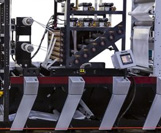
Tamarack Inline RFID Insertion Equipment
Tamarack MVW inline RFID Inlay Insertion Equipment
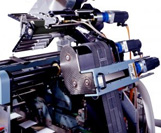
Tamarack’s inline RFID insertion equipment integrates seamlessly into flexographic or digital press lines. Servo-driven controls simplify installation and mounting structure provided by the press manufacturer results in a clean, finished appearance. It supports dry or wet inlays and is optimized for fast setup, operator-friendly adjustments, and short-run RFID jobs.
Offline RFID Integration
Offline integration offers greater flexibility, particularly when retrofitting RFID into a production environment that isn’t ready for a press-mounted solution. In this setup, RFID inlays are inserted into pre-printed or blank materials using a separate station. This equipment operates independently of the main press line and can feed rolls or sheets into post-processing systems.
This approach is ideal for piloting new formats, managing variable run lengths, or handling specialty substrates. While offline systems add material handling steps, they minimize disruption to your primary production flow and make it easier to test and scale.
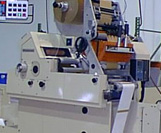
Tamarack MVW Offline RFID Inlay Insertion Equipment
Tamarack MVW Offline RFID Inlay Insertion Equipment
The MVW Offline platform applies RFID inlays to pre-printed rolls with high precision, using re-registration systems to ensure print-to-inlay alignment. It supports wet and dry inlays, multi-lane production, and multiple die-cut stations for finishing. The system is designed to accommodate roll-to-roll or roll-to-tag/ticket workflows with optional encoding and verification modules.
Tamarack offers both inline and offline RFID insertion solutions designed to enhance your packaging and labeling systems without disrupting your existing workflows. We provide servo-driven integration, multi-lane capabilities, and inlay verification to support high-performance RFID implementation. Contact us to discover more about producing high-quality RFID tags and tickets with RFID inlay insertion equipment.